
2a. Learn how rhythmic patterns are used with chords in piano music
In this lesson, you’ll learn how rhythmic patterns are used with chords in piano music and you’ll learn to identify the underlying block chords behind these rhythmic patterns.
When chords are used in piano music, the notes in the chord are not always played together as a block chord. Sometimes the pianist plays each chord note one after another in a particular rhythm that suits the song. When a pianist does this, you can describe it as ‘breaking the chord up into a rhythmic pattern’ or ‘arpeggiating the chord’.
The start of the video below demonstrates what is meant when a chord voice is broken up into a rhythmic figure. Watch from 0.00 to 0.45 and then stop the video and continue reading.
The video you just watched goes on to give examples from classical music where chords are broken up into rhythmic accompaniment patterns/figures. But, it is not just classical music that does this. You can find chords broken into rhythmic patterns in all styles of piano music. Listen to the piano part of the start of Adele’s ‘Someone like you’ embedded below and you will hear the notes of each chord played one after as a rhythmic pattern.
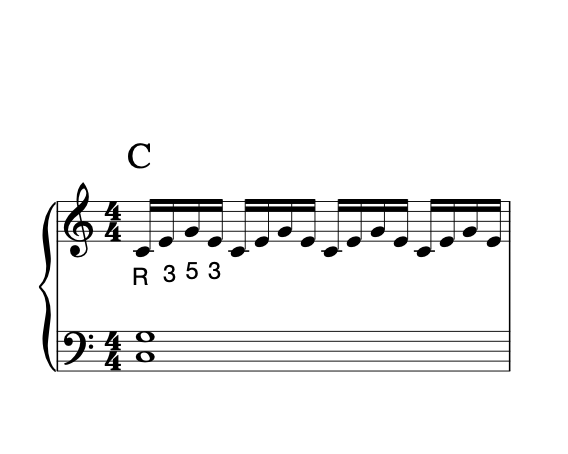
The chord that you hear at the start of ‘Someone like you’ (from 0:00 to 0:04) is broken up into a repeated four-note sequence that goes: root, 3rd, 5th, 3rd in the right hand part of the chord. Meanwhile, the LH part plays the root and fifth of the chord in the bass.
Below, you can see this pattern transposed to a C major chord:
- The notes are played in the following order: root (C), 3rd (E), 5th (G), 3rd (E), while the root (C) and 5th (G) are sustained in the bass.
This is written down in figure 1.1 below.
Figure 1.1
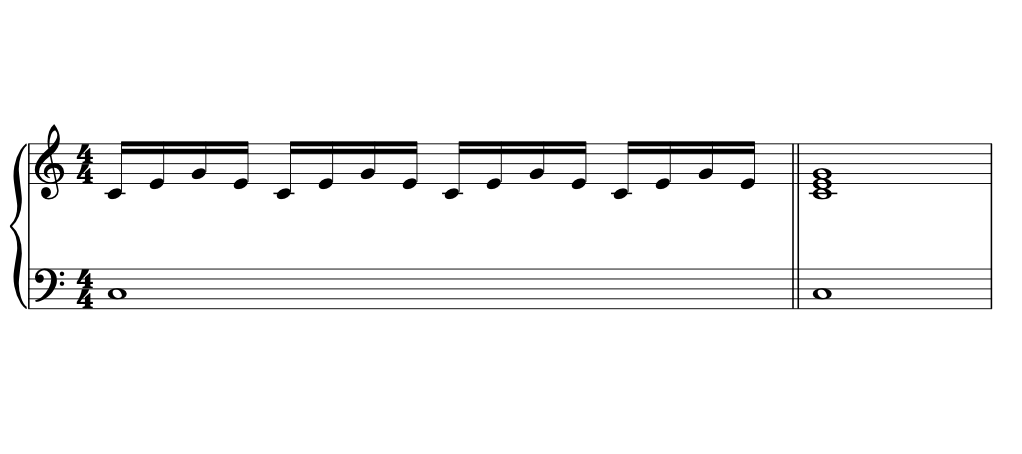
A helpful skill for pianists is to be able to recognise the simple block chord that underpins a rhythmic pattern like this. You can either do this in your head, or you can figure it out on paper. Simply adjust the rhythm of the pattern so that each note of the chord is played simultaneously, held for the full duration of the bar and this makes the basic chord which underlies the pattern clear and easy to recognise. Figure 1.2 below shows this.
Figure 1.2
In the next part of this lesson, you’ll practice identifying the underlying chord structure of a range of contemporary pop/rock ballad accompaniments and as a result, you’ll familiarise yourself further with the style of piano parts in this genre. So, when you’re ready, click ‘next’ and move on in the course!