
1b. Learn about voice leading
In this topic of the lesson, you are going to learn about a technique called voice leading. Knowing how voice leading works will help you develop an effective contemporary piano accompaniment later on in this course for your assessment task.
So, what exactly is voice leading? Simply put, voice leading is the way individual notes, or “voices,” move from one chord to the next. Good voice leading means that each note moves in a smooth way, often to the nearest possible note in the next chord and this creates a sense of flow in the music and makes the chords sound good.
Watch the first 30 seconds of the youtube video below. The video is written for people studying voice leading in a more advanced way than you are now, but towards 0:21 it gives a good representation of the movement of individual notes / voices in a chord progression and shows how these each form a melodic line in the progression. This will be helpful for you to see.
One way to understand what voice leading is, is to contrast a chord progression that is written with no consideration to voice leading with the same progression written out, where voice leading is used.
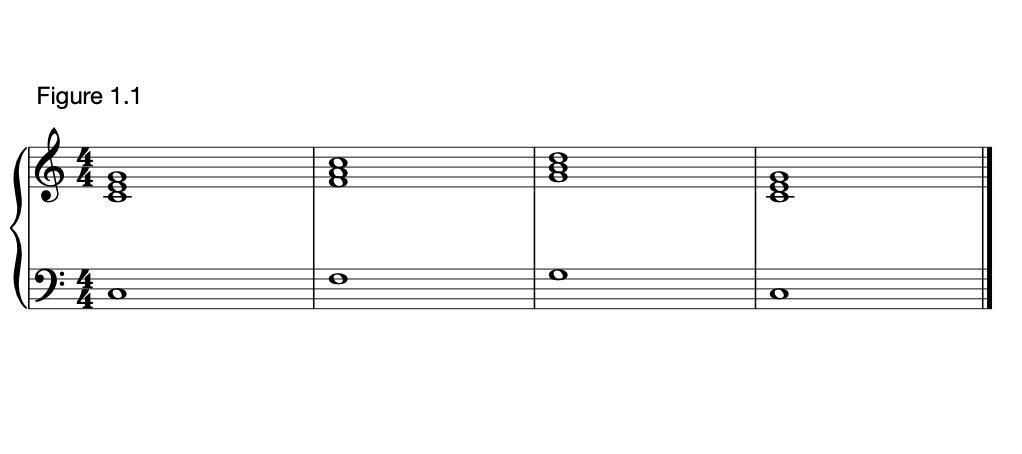
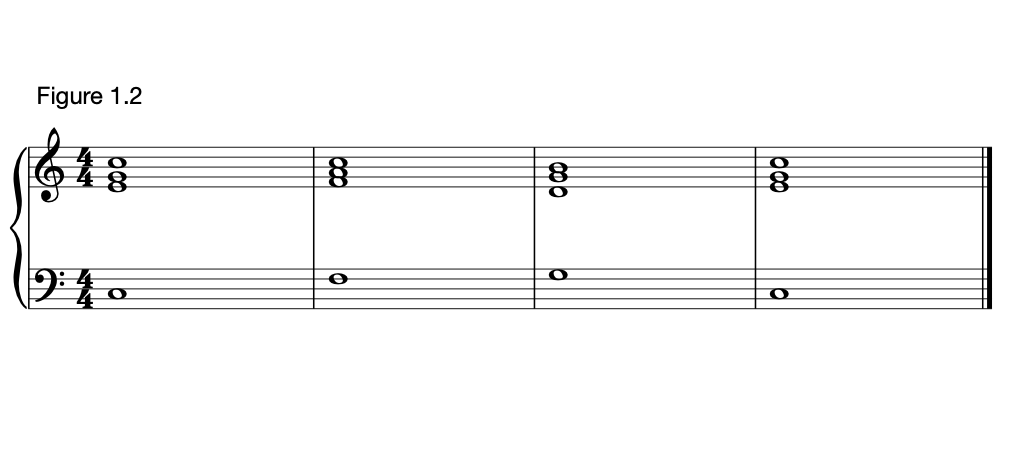
Look at the examples below. Figure 1.1 shows a chord progression where no attention has been paid to voice leading. Figure 1.2 shows the same chord progression with good voice leading. Try playing both progressions on the piano. In figure 1.1, the chord changes will feel jumpy or disjointed. In figure 1.2, the chords flow on from each other well and as a result, the chords will sound more expressive.
Let’s now consider what the features of good voice leading are. Continue reading and watching the videos below and take notes about the features of good voice leading on page 5 of your PDF workbook.
Features of good voice leading
- Minimal movement between chord notes in the upper chord voices.
- Chord notes are arranged so that each voice in upper parts move by the smallest possible distance, working like melodies in their own right. Whenever possible, voices move by step and this helps make the transitions from one chord to another feel seamless.
- Click here for a youtube clip which explains this point from 0:27 to 1:17.
- Common Tones Retained
- When a note is shared between two chords which come one after another, this note is placed in the same chord voice. Look at the C in the C Major (bar 1) and F Major (bar 2) chords. The note C is shared between both chords and is held in place in the same voice, minimizing movement and creating a smooth transition.
- For example, look at the C in the C Major chord (bar 1) and F Major chord (bar 2) of figure 1.2 (above). The note C is shared between both chords and is held in place in the upper voice of both chords, minimizing movement and creating a smooth transition.
- Avoidance of Parallel Fifths and Octaves
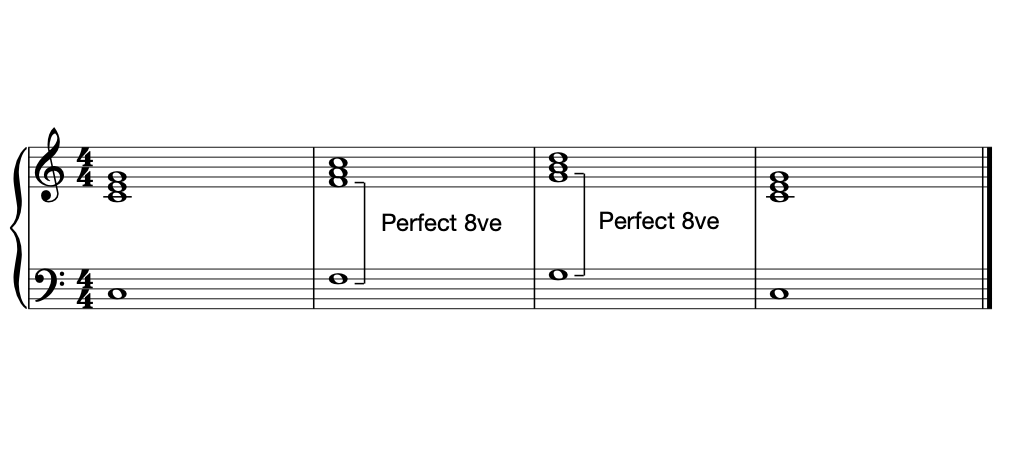
- The motion between chords doesn’t involve two voices moving in the same direction by a perfect fifth or in the same direction by an octave. Figure 1.3 (below) gives an example of parallel 5ths and figure 1.4 (below) gives an example of parallel 8ves.
Figure 1.3
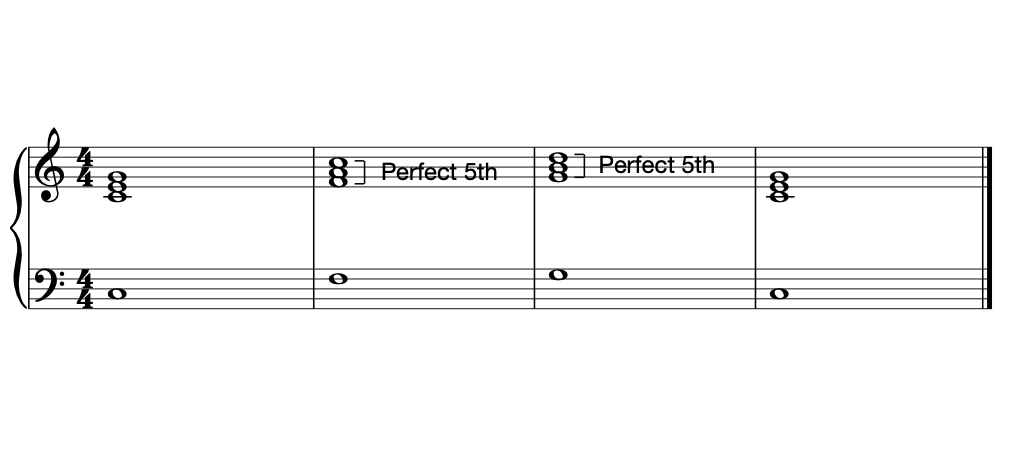
Figure 1.4
4. Correct Resolution of the Leading Note
- When a chord contains the leading note (the seventh degree of the scale) the chord voice which uses this note should move to the tonic (the first degree of the scale) or to the dominant (the fifth degree of the scale.) This movement from the leading note to either of these other scale degrees is referred to as ‘resolving the leading note.’ Resolving the leading note is important because it creates a strong sense of closure and stability in the chord progression.
- Look at the G Major (V) chord in the second to last bar of figure 1.2 (above). In this example, you can see that the leading note B is placed in the upper voice. This resolves correctly when the upper voice moves to the tonic C in the final C Major (I) chord in the final chord.
Now move on to the next topic in this lesson, where you’ll practice voicing chords in a progression using good voice leading techniques.